20 January 2006

BMO Appoints Downe as COO

  
The Globe and Mail, Sinclair Stewart, 20 January 2006

Bill Downe may have been unveiled as the heir apparent to Bank of Montreal chief executive officer Tony Comper, but that doesn't mean he has to move back to Canada. Well, at least not for another year.

The long-time BMO executive was promoted to chief operating officer of the bank yesterday, and handed responsibility for all of its main business lines, including retail banking, wealth management, the U.S. Harris Bank subsidiary, and investment banking arm BMO Nesbitt Burns Inc.

Mr. Downe, an Ontario native who now makes his home in Chicago, will also become the only second-in-command at a Big Five Canadian bank who does not live in the country.

"Where people physically reside is less important than it was 30 years ago," Mr. Comper said. "Bill spends four days a week here."

That could soon change, if Mr. Comper steps down as expected in the spring of 2007, when he turns 62. According to the Bank Act, bank CEOs must be Canadian residents, meaning Mr. Downe will have to move home if he gets the top job.

"I tend to be very close to the front lines," he said in an interview yesterday.

"I spend a lot of time in Canada. I think it will be necessary to split my time."

Mr. Downe, a corporate banker for many years before ascending to head of BMO Nesbitt Burns in 2001, said he will focus particularly on getting out "in the field" with the bank's domestic retail operations. He has been in charge of BMO's U.S. banking operation, including its retail branch network, since 2002.

BMO's board has been working increasingly on succession over the past 18 months, and much of the next year will be devoted to easing the transition. People familiar with the bank don't expect any sudden shifts in its low-risk strategy if Mr. Downe eventually takes the reins.

"Why would you change when you have a functioning corporate culture that has no problems?" one industry analyst asked.

Certainly, Mr. Comper and his likely successor share similar styles. Both favour a patient growth strategy, and both have a low tolerance for risk in corporate lending. Neither is particularly flashy, either. Mr. Downe, for example, drives a 15-year-old Mercedes-Benz -- not for the cachet, as one person explained, but because it still runs.

With the business groups reporting to someone else, Mr. Comper said he will devote more time to acquisition possibilities, particularly around BMO's Harris franchise.

"I put a lot of my energy into looking at expansion in the United States and I'm going to put much more of my time into that [now]," he said. If the Conservative Party unseats the ruling Liberals in next week's federal election, as is widely expected, Mr. Comper may also have time to dust off the bank's abandoned merger plans with Bank of Nova Scotia and reconsider his options. As one of the smallest of Canada's banks, and the one with the most established U.S. foothold, BMO would be the most sought-after target in any potential merger scenario.

As part of the executive shuffle at BMO yesterday, Yvan Bourdeau was promoted to CEO and head of investment banking at BMO Nesbitt Burns, where he was formerly president. Tom Milroy and Eric Tripp were named co-presidents of the unit. Chief financial officer Karen Maidment, meanwhile, will continue to report directly to Mr. Comper, and has added chief administrative officer to her title.
;

19 January 2006

Analyst Bullish on Insurance

  
Forbes, John Dobosz, 19 January 2005

Sam Subramanian, editor of AlphaProfit Sector Investors' Newsletter, is bullish on the insurance group as a whole and recommends buying into a sector fund to take advantage of the group’s strength. His top pick: Fidelity Select Insurance (FSPCX).

Several factors influence his bullish outlook, including the pricing power shown by property and casualty companies, along with consistent execution by life insurers and ongoing industry consolidation. Although insured losses have been huge in the past two years thanks to devastating hurricane seasons in 2004 and 2005, property and casualty insurers will make up for the big payouts with higher premiums.

“Property insurance rates in hurricane-affected states of the Southeast will likely increase significantly,” says Subramanian. “Ace expects property and casualty net earned premiums to grow 6% to 8% in 2006.”

Fidelity Select Insurance invests a minimum of 80% of assets in securities of businesses that are principally involved in underwriting, reinsuring, selling, distributing and placing insurance. Among the top holdings of the fund are MetLife, AFLAC, Prudential Financial and Allstate.

At 10% of holdings, its largest investment is in shares of insurance and financial services behemoth American International Group, the New York company that has been under pressure due to an investigation by the New York attorney general, a restatement of past earnings going back to 2001, and the inglorious departure of longtime Chief Executive Maurice “Hank” Greenberg.

Over the past year, Fidelity Select Insurance has returned 15.1%, closing Tuesday at $69.05 per share. The fund yields about 0.9%, carries an expense ratio of 1.04%, and earns a five-star rating from Morningstar.

Subramanian believes that a lot of the insurance industry's fundamentals point toward more growth.

“On the legislative front, President Bush has reauthorized the Terrorism Risk Insurance Program for two years beyond its originally scheduled expiration date of Dec. 31, 2005. This program provides government support for terror-related catastrophes,” say Subramanian, noting that it takes some burden off insurers.

“Among life insurers, Prudential Financial is executing well and is expecting earnings to grow 18% in 2006. Supplemental insurance provider AFLAC expects operating earnings to grow 15% in 2006, and the company is on a robust growth trajectory and has increased the number of agents by over 8% from year-ago levels,” says Subramanian.

Consolidation in the industry has also picked up in the past year. “In July 2005, MetLife completed its acquisition of Travelers Life & Annuity, and in October 2005, Lincoln National announced its merger with Jefferson-Pilot,” says Subramanian. “Given the fragmented and competitive nature of this industry, we believe insurers with strong balance sheets will pursue acquisition opportunities creating value for investors.”

There are, of course, Subramanian cites, natural or terrorism-related catastrophic events that may increase reimbursement and impact earnings. In addition, political interference (particularly in the P&C segment) may result in unfavorable changes. Lastly, he says, stock prices in the insurance group are generally sensitive to interest-rate movements since insurance is part of the financial services group.

”Notwithstanding such risks, we like the prospects for Fidelity Select Insurance and include it in the core model portfolio,” says Subramanian, who also notes that an alternative to the FSI is the streetTracks KBW Insurance exchange-traded fund from State Street Global Advisors and Keefe, Bruyette & Woods. The “Insurance ETF” has only been trading for two months, and there have been several days when zero shares have traded. Investors concerned about liquidity should stick with the Fidelity Select Insurance.
;

18 January 2006

BMO Increases Forecast for Bank Profits

  
The Globe and Mail, Sinclair Stewart, 18 January 2006

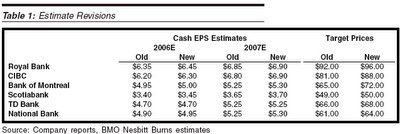
Canada's retail bankers may be about to get some relief after seeing their profit margins squeezed by a persistently low level of interest rates over the past three years. BMO Nesbitt Burns Inc. analyst Ian de Verteuil predicted in a report yesterday that spread compression is coming to an end, prompting him to increase his profit forecasts by between 1 and 2 per cent, and ratchet up his 12-month target prices -- in some cases significantly. Mr. de Verteuil suggested that higher profit this year for the banking group, coupled with a difference in profit trends relative to the U.S. sector and easing competitive pressures, bolster the case for higher targets. Bank of Montreal's target was increased $7 to $72, while Canadian Imperial Bank of Commerce's was moved up $7 to $88. Both are the most likely candidates to be acquired if Ottawa allows mergers between the banks, and Mr. de Verteuil suggested it was "prudent" to nudge up the multiples on these banks given the likelihood of the Conservatives winning the federal election.
;

17 January 2006

Analysts Bet on Big 3 US Banks

  
Earnings won't be spectacular, but analysts like shares of Citigroup, JPMorgan, Bank of America

CNNMoney.com, Shaheen Pasha, January 17, 2006: 12:59 PM EST

New York(CNNMoney.com) - Fourth-quarter earnings from banking titans Citigroup, JPMorgan Chase and Bank of America are expected to be summed up in one word: lackluster.

With an ever-flattening yield curve, an expected surge in bankruptcies and a decline in fixed-trading income from surprisingly robust third-quarter levels, analysts aren't counting on any breakaway surprises to the upside in the fourth quarter for the nation's banking leaders.

But rather than turn bearish on Citigroup, JPMorgan Chase, and Bank of America, analysts see plenty of potential for the stocks this year.

True, there are a number of negative headwinds that could put pressure on the companies.

The yield curve, which refers to the slope of rates in the Treasury bond market, is expected to have squeezed net interest margins in the fourth quarter and could continue to create a headache for bank profits in 2006. It briefly inverted in late December when the two-year note yield exceeded the 10-year yield, a rare occurrence that generally bodes badly for the economy and the financial sector in particular.

Banks and securities firms borrow money at short-term rates and lend at long-term rates. A flat yield curve, therefore, squeezes margins while an inverted one hurts a bank's profits.

"The banking industry got pinched with short-term rates in 2005," said Craig Woker, associate director of equities research at Morningstar. "But now that it appears the (Federal Reserve's) rate tightening is coming to an end, net interest margins should stay stable as banks get more visibility on how to price loans."

And Dick Bove, an analyst at Punk Ziegel & Co., said that while investors will likely be "agonizing over any net interest margins that are lost" in the fourth quarter, Wall Street should keep in mind that bank earnings are historically less affected by the slope of the yield curve and more directly hurt by a spike in loan losses.

"A careful analysis of bank earnings suggests that an increase in the loan loss provision at banks is the most compelling determinant of declines in bank profit," he said. "From 1950 to the present, every decline in bank earnings occurred in a year when the loan loss provision was rising."

Analysts added that investors may be taken aback by staggeringly high levels of credit card charge-offs in the fourth quarter as consumers raced against the clock to file for bankruptcy before the new, tougher bankruptcy laws took effect on Oct. 17.

But those concerns should also dissipate as bankruptcy filings slow down this year and banks likely see lower-than-expected charge-offs in the coming quarters, Bove said.

Jeff Harte, senior financial service analyst at Sandler O'Neill, said the capital markets outlook will remain the wild card in 2006. All three megabanks benefited from unusually strong third-quarter investment banking and fixed-income trading results. Fourth-quarter results should continue to be robust, although not as strong as the previous quarter -- a factor that may disappoint investors at first glance.

But among companies in the overall banking industry, analysts see Citigroup, JPMorgan and Bank of America as the best bets for investors.

From a valuation standpoint alone, the companies are ripe for the picking, said Morningstar's Woker.

Citigroup's stock ended the year up a mere 0.7 percent, while shares of JPMorgan managed to finish the year 1.7 percent higher and Bank of America fell 1.8 percent in 2005. Trading roughly at 10.5-times 2006 projected earnings, analysts said the companies were trading at a steep discount to their regional competitors, which trade at about 12.5-times earnings.

Of the three, Punk & Ziegel's Bove was particularly bullish on Citigroup's prospects. He said the company is poised for strong growth in its investment banking unit as M&A activity picks up steam.

And after a spate of regulatory woes in recent years, he said Citigroup's restructuring efforts -- such as the sale of non-core businesses, the implementation of a new rigid ethics model and the resignations of top executives that had served under the former CEO Sanford Weill -- should bear fruit and spur growth this year.

Bove has a 12-month price target of $62 on Citigroup.

Morningstar's Woker said JPMorgan's stock will climb as more details emerge regarding how successfully it integrated Bank One following the 2004 acquisition. He said that while earnings "numbers were ugly since buying Bank One," the company was focused on the integration and setting the stage for strong earnings growth this year.

"I would anticipate that this company will have the best bottom line growth by far in 2006 and 2007," he said, which should spark investors' interest. He said the company, which traded recently at about $40 a share, is fairly valued at $57.

And as for Bank of America, investors will be paying close attention to any benefits it derives from the $35 billion acquisition of MBNA, analysts said. Bove said the company will benefit from its trading operations and, while it has made a mark in serving the consumer market, he expects the company will continue to aggressively expand into the corporate finance arena.

Bove has a 12-month price target of $62 for the stock, which traded recently around $45 a share.
;

Cdn Banks to Disclose How Much Profit Goes to Executive Teams

  
The Globe and Mail, Sinclair Stewart, 17 January 2006

Canada's banks, bowing to pressure from investor advocates, have agreed to begin disclosing how much of their profit is used to fund the paycheques of their senior executive teams, according to people familiar with the matter.

Only Royal Bank of Canada, however, will have the information prepared in time for this year's proxy circular, which is scheduled to be mailed to shareholders at the end of the month.

Industry sources said the other members of the Big Five -- Bank of Montreal, Bank of Nova Scotia, Canadian Imperial Bank of Commerce and Toronto-Dominion Bank -- are working together on a co-ordinated approach to what is described as a cost of management ratio, or COMR.

These banks are expected to inform investors that they are working on a standardized approach, but this won't likely be ready until 2007.

Some of these banks questioned why RBC is using its own model, because it could make it more difficult for investors to compare the compensation practices across the industry.

"The whole point of this is so one bank can compare to another in a meaningful way," said one industry official. "For one bank to go out on its own, it doesn't make any sense."

David Moorcroft, a spokesman for RBC, said the bank decided last spring that it would implement a cost of management chart for investors. RBC is planning to publish two measures, one of which will benchmark pay for its top executives against the bank's profitability.

"We were clearly determined in terms of what we were going to do, and therefore didn't need to meet with the others," he explained. "We tried to provide a bit of leadership on it. We wanted to be pro-active and ahead of the curve."

Sources said the country's largest bank will focus its table on a small group of about seven senior officials, but Mr. Moorcroft declined to confirm details of the plan.

Sun Life Financial Inc. became the first financial company to offer the compensation disclosure in May after it was lobbied by investor activist Robert Verdun. Mr. Verdun asked the insurer to include the cost of compensation for its top 100 officials, but the two sides compromised, and Sun Life agreed to develop a table just for its executive team: a group of nine individuals.

The table enables shareholders to see what percentage of pretax profit has gone to executive compensation over each of the past five years. This will include salaries, bonuses and stock-based awards.

Mr. Verdun mailed similar proposals to the major banks for consideration, before annual meetings this March, but withdrew them recently after the banks agreed to disclose the information.

"I came up with this as a tool that causes downward pressure, or at least moderation, in executive compensation," Mr. Verdun said. "I think that could be very useful to investors."

Bill Mackenzie, president of advocacy group ISS Canada Corp, welcomed the improved disclosure at the banks, where lucrative compensation for executives has been a lightning rod for criticism.

"I think it's a great idea, because all this talk over the years in their proxies is how the [pay] packages are linked to performance," he said. "They don't really talk about how the overall performance tracks with compensation."
;

Average Cdn Spends $760 in Pocket Cash a Month

  
The Globe and Mail, 17 January 2006

The average Canadian spends $100 on discretionary items every four days, while nearly one person in four can't even make it last 48 hours, a survey released yesterday by Mackenzie Investments suggests.

The survey found that the average Canadian's "burn rate," or how quickly discretionary money is spent, totals about $760 a month.

With the Canadian personal savings rate reported to be in negative territory, experts say that money could be invested, saved or used to reduce debt.

"It's truly time for Canadians to stop living beyond their means and make saving and investing mean something in their lives," states Rhonda Katz, a consultant to Mackenzie Investments.

"It's a simple concept that is continually ignored, and it doesn't mean Canadians should stop spending on things they want and need. Making wise spending choices can help you live comfortably today and when you retire."

The survey found that about 80 per cent of Canadians own a credit card, and of those, nearly half carry a balance -- with the average being $1,710.80.

Atlantic Canadians, meanwhile, were found to be the best at making their money last, while Quebecers spend their cash the fastest, with a quarter reporting they spend $100 in half a day.

"Men and women equally shoulder the blame when it comes to who burns through the most money in their household: 59 per cent of women and 55 per cent of men say they spend the fastest," the study says, noting most discretionary cash is spent on entertainment and dining out.

The telephone survey of 1,500 adult Canadian was conducted between Dec. 6 and 11, 2005. The results are considered accurate within 2.5 per cent, 19 times out of 20.
;

16 January 2006

BMO NB Research Comments on Cdn Banks

  
BMO Nesbitt Burns Research Report Summary, 16 January 2006

Spreads – Mix and Interest Rates Appear to Have Turned the Corner

In our report, Lower Spreads are Structural (06/27/05) we indicated that we believed that about half of the decline in spreads over the past four years has come from mix, with low absolute levels of interest rates and competitive pressures combining for the remainder.

As we look at each of these variables, there is certainly some cause for optimism not that spreads will return to the levels seen in 2001, but that spreads should be stable or even rise modestly. We will deal with the first two of these factors mix and absolute levels of interest rates below. The third, competitive pressures, is more complex and is dealt with in the following section.

The shift in mix from high-spread, unsecured lending to lower spread, secured lending remains a reality for the future. Banks have generally convinced themselves (as well as their front-line staff and customers) that using secured borrowing capacity is a good idea when compared to unsecured. While this clearly results in lower spreads (often 300 basis points lower), it allows banks to put up less capital and produces structurally lower loan losses. Having said this, we believe that most of the transition is already complete. As we show in Table 3, we believe that the change in 2005 is relatively minor compared to that seen in 2003 and 2004. More stable mix argues for more stable spreads in the coming years.

On the issue of interest rates, the recent increases in administered rates are certainly a positive for Canadian bank core spreads going forward. When the Prime Rate moved below 4% in early 2002 and again in mid-2004, this was clearly a problem. With core margins in the banking system in the 3.50-3.75% range, a Prime Rate of below 4% put pressure on spreads. With very low absolute levels of interest rates during much of 2004 and early 2005, banks were already at zero rates on many deposit products (particularly the 'free' deposits in certain products such as chequing accounts and savings accounts with de minimus rates). As Prime continued to fall, banks were not able to re-price these deposit rates to match the lower yields on loans.

In addition, other deposit balances hit 'psychologically' low levels. GIC rates of less than 100 basis points are often not on the surface sufficiently enticing to encourage consumers to lock in their deposits. Why not just keep the money in a chequing account? The problem here is that banks would need to lock in some funds to ensure that they were not widening their duration gap. In reality, banks generally took the more conservative route and paid a bit more for the term deposits at the expense of spreads.

With the Prime Rate having risen from 3.75% in Q3/05 to 5% currently, one could argue for 8-10 basis points of margin expansion in 2006 when compared to the trough of 2005. Whatever the true number, the reality is that this has gone from a negative to a slight positive.

Competitive Pressures – Some Cause for Optimism Among Bankers

The third factor that has caused spreads to collapse in the Canadian P&C banking system (shown in Chart 1) is competitive pressures. We noted as far back as 2003 in our report, 'Are we Cooking the Golden Goose?' (06/02/03) that competitive pressures on mortgages and deposits were developing. Today, the trend appears to be in the other direction.

A) Signs of Abating Pressure on the Deposit Pricing Front

It is difficult to be definitive on pricing trends in banking. Banks have the ability to source funds in a variety of ways, and can use the proceeds to finance a variety of assets. Furthermore, posted rates are more indicative than they are rigid. Fortunately, there is somewhat more visibility on the deposit side- particularly on high-interest saving accounts. We note that with deposits making up 60% of spread revenues, pricing on this side of the balance sheet is very important to overall spreads.

It is against this backdrop that we closely monitor posted rates on these products, particularly for ING, PC Financial and Manulife, the relatively new entrant ICICI, and the high-interest accounts offered by Scotiabank and Bank of Montreal. As we show in Chart 2, the 75-basis-point increase in Prime since mid-2005 has only produced a 25-40 basis point move in rates on these accounts.

Interestingly, ING no longer appears to be leading the charge for higher deposit pricing as rates rise. Of course, there are other variables- BA rates and other non-administered rates- but this analysis still illustrates that there appears to be some sanity returning to pricing in this segment.

B) ING Bank of Canada – Is the Bloom Coming Off the Tulip?

Note the following comments are on ING Bank- the deposit taking institution, not ING Canada- the property and casualty insurer.

There is no doubt ING Bank of Canada (ING) has been a huge success story over the last seven years. By conducting business mainly over the Internet and telephone, offering very attractive interest rates on deposits and residential mortgage loans with no fees, and advertising aggressively, ING has had a meaningful impact on retail banking practices in Canada. In many ways, the success of ING has been the poster-child for competitive pressure in deposit pricing.

ING now has close to a 3% share of the Canadian retail deposit market. Its success illustrates the power of the Internet and sophistication of the Canadian consumer. Competition is alive and well. Table 4 shows growth rates at ING Bank.

However, recent evidence suggests the bloom may be coming off the ING story and that ING, although still a force in Canada, should not be viewed as a major threat to the Canadian banks' competitive position in retail banking. This evidence includes lower profits and lower growth, and could explain why ING appears to now be somewhat less aggressive. We deal with these two issues below.

As illustrated in Table 5, ING's after-tax earnings are projected to decline 15% in 2005 with a reduction in ROE to 5%. Canada's six largest banks are expected to record an ROE near 17% in fiscal 2005 (inclusive of Enron charges). ING's earnings would have declined even further in 2005 if not for the massive $830 million infusion of new common equity from the Parent over the last two years. In terms of common equity, we believe ING is currently over-capitalized by about $700 million. Removing this cost-free source of funding would reduce estimated net income for 2005 by over $20 million (or 30%), although ROE would increase to 8% from 5%.

The main factor accounting for the erosion in profitability is a falling interest rate spread. As illustrated in Table 5, ING's interest rate spread is expected to decline 15% to 1.58% in 2005.

ING borrows short and lends long and is therefore negatively leveraged to rising interest rates and a flattening yield curve. The yield curve in Canada was abnormally steep in 2004 and has flattened by over 65 basis points (on average) in 2005 (using the spread between the 3-month Treasury Bill rate and the 5-year mortgage rate as a proxy). A further flattening of the yield curve is possible.

In addition, ING's ability to generate investment security gains on its large portfolio of mid-term debt securities is limited in a rising rate environment. Also, the flow of mortgage prepayment fees slows in a rising rate environment.

It should be noted that the erosion of ING's net interest spread in 2005 was moderated by several factors, including the common equity infusion noted previously; asset mix changes as higher yielding loans grew faster than security investments; and less aggressive pricing on the deposit side.

One specific vulnerability of ING is the relative lack of non-interest income. For a typical Canadian bank, non-interest income is 33% of total revenues in the P&C Bank. ING, however, gets over 90% of total revenues from spread revenues and the remainder from non-interest revenues (in the first nine months of 2005, spread revenue was over 97% of total revenues). This means that spread compression is much more painful for ING than for a typical Canadian bank.

In addition to pressure on profitability, it appears as if ING's balance sheet growth, although still impressive, is slowing. We show the growth specifics of ING's balance sheet in Table 6.

On this front, we believe considerations include: 1)ING's higher base: growth from a base of $1.5 billion is obviously easier than from a base of $15 billion; and, 2)more competition. On the deposit side of the balance sheet similarly high deposit rates are offered by Manulife Bank, President's Choice Financial, several credit unions, Bank of Nova Scotia and Bank of Montreal. All large banks are more aggressive in offering better rates and money market alternatives to targeted customers. On the mortgage lending side, most of the large banks are now utilizing the mortgage broker channel while at the same time expanding their own captive sales forces. Discounting from posted mortgage rates by the large banks has increased, again mainly for targeted customers.

We believe that growth in loans and deposits in 2006 for ING will be even below that experienced in 2005. It is also interesting to note that ING has begun to change its formula somewhat. Late in 2005, the bank began offering consumers a 'discount' off their posted rates (i.e., a premium on net new funds received before December 31). We note that the ING consumer proposition so far has been consistent: it offers everyday best value to all. It will be interesting to see whether ING begins to look more like other banks which offer more selective pricing across their product and customer bases.

C) Closing the Loop on P&C Profitability

Spreads do not drive bank share price; it is the impact of spreads on bank earnings that is important. In our report on Retail Banking, 'Canada's Castles Revisited' (10/28/05), we indicated that the outlook for 2006 is good. This is despite the fact that asset growth in 2006 will probably be lower than in 2005. On the other hand, we noted that asset growth of 8-10% in 2005 was mitigated by a reduction in spread of about 15 basis points. In fact, spread revenue only grew by 4%, which is less than nominal GDP.

As we look out to 2006, we believe that asset growth will slow (though there are no signs of this occurring as yet) but that flat to slightly rising spread will allow spread revenue to grow faster in 2006 than in 2005. Taking all this into account, we believe that growth in P&C banking profitability in 2006 will be in the 'low teens.'

Furthermore, with ING profitability well down from the past few years, it appears as if the most potent competitor is less able to create problems in the medium term. P&C earnings (which are the higher multiple parts of the banks) look to be higher and risks appear to be lower.

Not Everything Is Rosy

It is clear that many factors are aligning that point to higher bank earnings in 2006. Having said this, there are a couple headwinds.

First, it is likely that we will see some modest escalation in loan losses after several unusually good years. We are currently expecting loan losses of $2.8 billion in 2006 compared to $1.8 billion in 2005, with an additional $500 million in 2007.

Second, Canadian banks do not generate a large amount of profits from playing the slope of the yield curve, but it is naïve to say that a completely flat curve has no impact on bank earnings. Banks that we believe are most negatively affected by the flat yield curve are BMO, BNS and NA.

Third, the strong Canadian dollar does create some drag on non-Canadian earnings on translation of profits. We believe that a 10% appreciation in the Canadian dollar takes about 2% off bank estimates, with BNS and BMO most impacted. However, we note that Canadian banks are less exposed to moves in currency than are most other sectors of the S&P/TSX.

Valuation Compared to U.S. Peers

The single biggest concern that we have had on Canadian bank stocks is the ongoing widening valuation gap between Canadian bank stocks and those of their U.S. peers. Specifically, we note that after spending most of the past two decades trading at 80% of U.S. bank valuations, Canadian banks have moved to a material premium over the past couple of years (Chart 3).

There are several fundamental factors that suggest that the gap is valid. Canadian banks have established a 'profitability premium,' their balance sheets are stronger and they appear to be building a lower-risk business model.

From our perspective, this is best evidenced in the current environment where the yield curve is flat (or inverted depending on the duration monitored). We are amused by the fact that U.S. banks seem to be taking 'one-time' charges to deal with the fact that they have guessed wrong on the yield curve. U.S. banks typically lend longer than they fund. Canadian banks are highly unlikely to be caught in this manner because of tighter matching, and because they are much more focused on short-term consumer lending than on commercial loans.

We believe the best indication of this is the relative changes in analyst estimates for Canadian and U.S. banks. As we show in Chart 4, Canadian bank earnings estimates have been rising whereas U.S. bank estimates have been falling. This is despite the fact that Canadian banks have had more headwinds from currency than their U.S. peers.

It appears to us that earnings revisions on U.S. banks are likely to continue to be negatively biased whereas the opposite is true in Canada. In the short term, this should continue to support the valuation gap that has opened.

Please Don’t Make Us Talk About Mergers

If there is one statement that indicated the political morass that is bank mergers in Canada, it is the one made by current (as of the time of writing) Prime Minister, Paul Martin. He indicated to Reuters in early January 2006 that, 'I think that the issue is one that's going to have to be resolved, will have to be dealt with.' The lunacy of this statement is that the current government (during which time Mr. Martin has been either Prime Minister or Minister of Finance) has had over seven years to deal with this topic but has come up with numerous deliberate stalling tactics so as not to do so. We list the chronology of these stalling tactics in Appendix 1.

We are not making the case for or against bank mergers' impartial, well-informed individuals could easily come to different conclusions on this topic. Our view is that the biggest problem is the lack of clarity. The Canadian government needs to either allow banks to enter the labourious merger process (by removing artificial hurdles) or declare a moratorium for some period. We believe that either approach would be acceptable; and would be beneficial to the industry. At the very least, banks would be better able to execute on long-term strategy.

A minority government is unlikely to be an environment where bank mergers would be allowed. On the other hand, a Conservative majority government would likely increase the odds of an attempted bank merger. We caution investors of three things: 1)the Conservatives may not win a majority (or even a minority); 2)a political party that held different views when in 'office' than they did when they were in opposition, would not be novel; and 3) the merger review process remains a complex process with many opportunities for politicians to extract concessions (i.e., limits on branch closures, head count reductions, etc.)

Despite all of that, we believe that a prudent portfolio manager would be advised to own one of either BMO or CM to ensure that they are insulated from possible merger speculation. Fortunately, we already recommend CM for fundamental reasons and we believe that this remains appropriate. We have used slightly higher target P/Es than in the past for BMO and CM in setting our target prices.
;

Manulife's Fast Growing Fund Business

  
The Globe and Mail, Keith Damsell, 16 January 2006

Quick -- what was the fastest-growing major fund company last year? If you guessed one of the big banks or aggressive CI Financial Inc., you'd be wrong.

It may come as a surprise but the retail funds assets under management of insurance giant Manulife Financial Corp. grew by a stunning 60 per cent in 2005, climbing from about $4.9-billion in 2004 to $7.8-billion at the end of December. The nearest major firm is Bank of Montreal's BMO Funds, reporting a 28-per-cent gain in assets last year to $25.1-billion.

"A lot of people have overlooked us," said Donald Guloien, chairman and chief executive officer of MFC Global Investment Management, Manulife's investment arm that manages about $240-billion in assets.

"It's almost like coming out of the closet," he said. "Since 2002, we've actually grown very, very nicely and performance -- knock on wood -- is fantastic."

Manulife was largely absent from the fast-growing fund business a decade ago. Elliott & Page Ltd., the investment arm that was part of the 1995 acquisition of North American Life Assurance Co., focused largely on institutional clients. In 1997, the company lost the fight to buy Altamira Management Ltd. and senior management balked at paying a premium to build its presence in the retail fund business.

Instead, Manulife shifted its focus and reviewed its in-house capabilities. A 300-strong team of investment managers operating in silos across the company were brought together. The firm was among the first to acknowledge the income needs of an aging population; the well-regarded Elliott & Page Monthly High Income Fund, managed by Alan Wicks, has swelled to about $3.4-billion in assets. Meanwhile, the company built a strong sales team able to leverage off of Manulife Securities' vast brokerage network. There are now about 30 fund wholesalers across the country catering to financial advice channels.

"Manulife has really had a big turnaround over the last three or four years," said Dan Richards, an industry marketing consultant. A combination of building a retail focus, product innovation and distribution are behind the firm's success, he said.

But organic growth will take Manulife only so far in the retail fund space. Mr. Richards contends the company needs greater scale within its fund manufacturing and distribution operations if it wishes to compete with the big banks.

"The question is how do you grow that business to become a major player?" he said. "I've got to believe that if somebody significant came on the block . . . they would be a candidate to take them out."

Manulife has not ruled out potential acquisitions but "we see great opportunities for organic growth," Mr. Guloien said. "People buy you for an investment management team. . . . We care a lot about performance and being able to keep delivering."
;

TD Ameritrade's U$6 Dividend

  
Barron's, Shirley A. Lazo, 16 January 2006

ON JAN 4, SHAREHOLDERS of Ameritrade Holding okayed its acquisition of TD Waterhouse Group's U.S. retail securities business from Toronto-Dominion Bank for $2.9 billion in stock.

That will give Toronto-Dominion 32.6% of the shares of Ameritrade, making the Canadian banking concern the biggest stockholder in what will be called TD Ameritrade. The new company expects to lead the online brokerage industry in trades, with some 239,000 daily.

In connection with the deal, Ameritrade on Dec. 5 declared a distribution of $6 a share, payable Jan. 24. No ex-date has been set, but it's likely to coincide with the payment date. Toronto-Dominion won't get the distribution, however, because the Jan. 17 record date for the transaction precedes the date on which any Ameritrade stock will be issued to the bank.

For those who are entitled to the cash, there are a couple of key questions.

THE FIRST IS WHETHER the special distribution is a dividend.

In a recent report, Robert Willens, Lehman Brothers managing director, writes that the distribution is a dividend only to the extent that it "comes out of earnings and profits (E&P), either accumulated or of the taxable year in which the distribution is made."

Since the Ameritrade distribution is being made early in the year, Willens says the portion that will be a dividend won't be conclusively determined until early in 2007, when Ameritrade's 2006 operating results, including the activities of TD Waterhouse, will be known.

Another element that must be considered is an IRS ruling that, for tax purposes, whoever holds the stock on the record date is entitled to a declared dividend. (In the case of large dividends, the ex-date usually follows the record date.)

Accordingly, Willens maintains, "if the stock is sold after the record date but before the ex-dividend date, the amount paid by the buyer of the stock represents, in reality, payment for two separate items: the stock and the right to receive from the seller" a sum equal to the distribution.

In the Ameritrade transaction, the buyer's basis in the dividend right will be equal to $6, and there will be no gain or loss on collection of the money. On the other hand, Willens observes, "a portion of the amount received by the seller will be treated as dividend income." Thus, the seller, not the buyer, will treat that amount as qualified dividend income, eligible for a relatively low tax rate.

Such income is taxed at a maximum 15% if the stock on which the payout is made is held more than 60 days in the 121-day period beginning 60 days before the ex-dividend date. If the holding period requirement isn't satisfied, the tax rate jumps to the holder's top bracket (up to a maximum of 35%).

Another question raised by the Ameritrade deal is whether the dividend can be "stripped."

Stripping is the process of converting short-term capital gains, which can be taxed at hefty rates, into dividend income, which is taxed at 15% or less.

"A dividend strip is most effective if a loss from the sale of the stock on which the dividend was paid can be classified as a short-term capital loss," Willens comments. If so, the loss can offset the investor's unrelated short-term capital gains, which, in turn, are "replaced by dividend income, eligible to be taxed at preferential rates."

While Congress has tried to discourage stripping, it hasn't eliminated it. Therefore, writes Willens, if a dividend is considered extraordinary, any loss from the sale of the stock on which it was paid will be a long-term capital loss, to the extent that the loss doesn't exceed the dividend. Long-term capital losses can offset an investor's long-term capital gains (which otherwise are taxed at 15%).

"Of course," Willens adds, "replacing long-term capital gains with dividend income [which is taxed at the same rate] does not provide the investor with a tax advantage."

FOR STRIPPING, Willens observes, a dividend is considered extraordinary if it equals or exceeds a "threshold percentage" of the cost basis of the stock on which it's paid. For common shares, that's 10%.

Alternatively, the stock's fair-market value on the day before it goes ex-dividend can be used to determine whether the dividend is extraordinary.

If the dividend element of the distribution is less than $2.50 a share, Willens says stripping possibilities will clearly exist. The big problem is that no one will know whether the Ameritrade dividend is extraordinary, and thus a good stripping candidate, until it's too late -- early 2007 when the results of Ameritrade's 2006 operations are disclosed.

The bottom line: "Except in cases where the taxpayer has only short-term capital gains (against which the long-term capital losses...can be offset), the Ameritrade special distribution, in light of the uncertainty, is probably not an attractive candidate for dividend stripping."
;

14 January 2006

Tory Statement Quashes Bankers' Insurance Hopes

  
Financial Post, Pail Vieira and Wojtek Dabrowski, 14 January 2006

Ottawa, Toronto - A Conservative government would deny chartered banks the right to sell many types of insurance directly to customers in their branches, the Stephen Harper-led party said yesterday.

The revelation, contained in a one-sentence statement in the party's official platform, could represent a major setback for the banks should the Conservatives emerge as victors following the Jan. 23 vote. Opinion polls are indicating as much with 10 days to go, with the only question being whether the Conservatives win a minority or majority.

The banks had fought for years for these specific changes to the Bank Act regarding insurance. "We're disappointed," said an official at one of the Big Five banks. "There's no economic rationale and obviously consumers are better served when they've got more access to products, which if you're retailing through branches, you would."

The major banks had put a lot of hope in federal legislators changing the laws, as indicated in an interview Gordon Nixon, chief executive of Royal Bank of Canada, gave last month to the Financial Post.

He said Royal Bank believed changes should be made to the Bank Act when it comes up for review this year. "And the one that we've been pushing the hardest on ... is the ability to distribute insurance products through our bank-branch network."

The banks have been permitted to buy insurance operations since 1992 and have been doing so aggressively. But Canada remains one of the few industrialized countries that imposes restrictions on direct insurance sales by banks through their branches. The banks' hopes seem dashed if the Conservatives, as expected, form the government.

A spokeswoman for the Canadian Bankers Association said it expects the government to review the Bank Act, as Ottawa is obligated to do, and the banking group will table its position at that time.

Banks have been frustrated for years with Ottawa, most notably on failing to permit bank mergers, or at least provide rules on possible mergers. An Ottawa source close to the banks said banking officials are not convinced a Conservative government would behave any differently than the Liberals.

However, Conservative finance critic Monte Solberg told the Reuters News Agency yesterday that a Conservative government is indeed ready to consider mergers among banks and set up a clear vetting process to consider proposals.

The Conservative position on in-bank insurance sales had come as no surprise to some observers. A letter dated Dec. 16 to the Insurance Brokers Association of Canada (IBAC), states that Mr. Solberg "has always taken the position that we oppose banks retailing insurance through their branches. "Given the upcoming Bank Act Review we have recently received many questions from your brokers to clarify our policy on this. Be assured that our position remains exactly the same."

Despite Mr. Solberg's assurances, Ottawa sources say lobbyists for insurance brokers pressed the Conservative party to announce its opposition to in-branch insurance retailing.

In a statement, Dan Danyluk, IBAC's president, applauded the Conservative party's move, saying allowing bank-branch insurance sales would "quash healthy competition" by giving banks an unfair advantage over other players.
;

13 January 2006

BMO's Comper Setting the Stage for an Orderly CEO Change

  
The Globe and Mail, Andrew Willis, 13 January 2006

When the big banks choose a new leader, the succession can be anything from a winner-take-all cliffhanger to a boring, well-telegraphed passing of the crown. Bank of Montreal, which has seen its share of corner-office drama in the past, seems bent on turning in a low-key affair when incumbent chief executive officer Tony Comper steps down.

Mr. Comper is expected to lay out succession plans at the bank's annual meeting this spring in Calgary. Although there are at least four strong candidates for the top job, veteran corporate banker William Downe is expected to emerge as heir apparent.

Mr. Comper, the quintessential organization man, turned 60 last April. The milestone added emphasis to normal CEO chats with the board about the next generation of leaders. Mr. Comper, approaching his seventh anniversary as CEO, is said to be planning an orderly transition that plays out over as much as two years, with Mr. Downe and other executives steadily picking up new responsibilities.

By telegraphing what's playing out both internally and externally, Mr. Comper will avoid the cage match that was fought a few years back at CIBC, when one candidate won the top job and his rival promptly quit.

When the baton was passed in recent years, at TD Bank, Scotiabank and CIBC, each bank anointed a leading candidate. This individual moved into a president's or chief operating officer's job for seasoning and to give the board a chance to watch him work.

Mr. Comper was BMO's president for nine years while the colourful Matthew Barrett was CEO, but didn't fill the president's role when he took the top job following Mr. Barrett's surprise resignation in 1999, and subsequent re-emergence in British banking.

Peers of Mr. Comper's, such as Royal Bank's John Cleghorn and CIBC's John Hunkin, have chosen to exit the stage gracefully at the age of 60, leaving plenty of time for new adventures in life.

Mr. Comper and his wife Elizabeth have a range of philanthropic interests. He has donated countless hours as head fundraiser for the University of Toronto and chairman of the university's governing council. She recently founded a group committed to stopping anti-Semitism. Mr. Comper is also fond of the feel of a well-struck 5-iron.

The focus on long-term leadership reflects the confidence among the board and senior ranks that the bank will remain independent. No one is counting on the government to change its opposition to in-country mergers. BMO has been twice to the altar, with no ring.

With the arrival of a new CEO still a year or two away, here's the talent the board, and the bank's internal odds makers, view as contenders.

William Downe: The clear front-runner, this 53-year-old Montreal native has been with the bank for 23 years, with much of his career spent in the U.S. market that BMO is targeting for future expansion. After stints in Houston, Denver and Chicago, he moved to head office in 1998, where he has turned in strong results running the investment dealer, treasury and wealth management arms of the bank.

Karen Maidment: Universally respected as the bank's chief financial officer, the knock on her is that she hasn't been around the bank long enough, or worked in enough areas, to step up as Canada's first female bank CEO. Ms. Maidment, an accountant by training, joined the bank in 2000 from the CFO's spot at Clarica Life Insurance Co., which was taken over by Sun Life Financial. She still lives in Cambridge, Ont., near the Clarica head office, and commutes to Toronto.

Robert Pearce: Part of the next generation of leaders, the fortysomething runs one of the most profitable parts, the bank's retail branch network. He's won kudos for the way he's handled cutting-edge (occasionally bleeding-edge) initiatives, such as telephone and Internet banking and North American electronic banking group.

Frank Techar: A Minnesota native, he is president and CEO at Harris Bankcorp, one of the largest banks in the Chicago area and a focus on BMO's growth plans. He joined in 1984 as a corporate banker and headed up a small-business banking push before taking the top job at Harris. Mr. Techar has done a series of successful small acquisitions in the Chicago area and the BMO board has signed off on future takeovers of up to $2-billion.

Banking on a successor

Tony Comper has turned 60 and is looking ahead to life after Bank of Montreal. To make the changeover smooth, BMO looks set to telegraph the heir apparent and avoid destructive infighting. So far, attention has centred on four candidates, with one given the clear nod as most likely.

William Downe

The leading contender because he's got a wealth of U.S. experience, and that's where the bank wants to expand, and because he's run every major part of the bank save its retail branches.

Odds: The front runner

Karen Maidment

While Tony Comper would love his legacy to include Canada's first female bank CEO, a career spend mostly in insurance means BMO's chief financial officer doesn't have the breadth of experience.

Odds: An outside chance

Robert Pearce

He's built, or pruned, net-generation bank systems on the Internet and phone, and now runs the retail branches.

Odds: A strong contender in the next race

Frank Techar

Running Chicago-based Harris Bankcorp is great training for the top job in Canada, but it's also too soon for this pony to contend in the leadership race.

Odds: Also on track for the next CEO sweepstakes.
;

12 January 2006

Credit Card Fees

  
The Wall Street Journal, 12 January 2006

Perhaps Dustin Hoffman's rich adviser had it right when he pronounced in "The Graduate" that the future is in "plastics." Last year the credit card industry handled more than $2 trillion in consumer transactions and gobbled up nearly $30 billion in fees, according to the Nilson Report newsletter on the credit card industry. These fees are now the source of mounting angst among retailers, which have launched 47 antitrust lawsuits against the credit card companies for alleged collusion in setting these fees.

Retailers have also rushed to Washington demanding that Congress impose a de facto price cap on credit card charges -- as Australia and the European Union have already done. This campaign against credit card fees and the clamor for price controls sound eerily familiar. A few years ago dim-witted politicians employed price controls to try to limit fees for using ATMs. In localities where that was tried, the result was not lower fees, but fewer ATMs, and thus much less convenience for customers.

Once upon a time, credit cards were the playthings of the rich. But today credit (and debit) cards are a ubiquitous feature of the U.S. economy, with three of four adults owning either credit or debit cards as America moves closer to becoming a "cashless society." Certainly the shift toward plastic payments suggests the industry is satisfying its customers.

The controversy surrounds the way Visa and MasterCard and their issuing banks make money -- which is by collecting what is called an "interchange fee" from merchants. This fee averages about 1.75% of the sales price of the good or service purchased. The average convenience store paid $31,000 in interchange fees in 2004 -- a figure approaching the average per-store pretax profit of $36,000. The retailers say this charge is a "hidden transaction tax on consumers."

This complaint ignores the value added that the credit card company provides. Consumers benefit in an obvious way: They don't have to carry around wads of cash, because the credit card bank essentially holds the funds for them. Retailers benefit too: They don't have to deal with cash transactions, which minimize theft at the cash register. They receive a guaranteed payment from the bank that issues the credit card (i.e., no bounced checks). Most importantly, they lure customers into their stores by accepting a credit card of choice. If the retailers didn't think these benefits exceeded the costs of the interchange fee, they could simply refuse to accept credit cards at the register.

That said, many small retailers operate on thin profit margins and there does appears to be some merit to their complaint that credit card fees have risen above the levels one would expect in a perfectly competitive market. Interchange fees in the U.S. are among the highest in the world.

These fees, according to a recent study by economists at the Federal Reserve Bank of Kansas City, have also been paradoxically trending upward in recent years when the industry's costs due to technology and economies of scale have been falling. But these rising interchange fees have also corresponded with lower annual fees charged to cardholders and increasingly lucrative incentive packages to entice shoppers to pay with plastic: cash back rewards, airline frequent flyer miles, and even exotic benefits like free "concierge service" to get tee times on the golf course.

We're all in favor of more competition to drive down interchange fees. But the argument retailers are making that this industry operates as a cartel is highly unpersuasive. There are five major competitors in the credit/debit card market aggressively vying for customers: Visa, MasterCard, American Express, Discover, and the newest player, Star.

Meanwhile, mega-retailers such as Wal-Mart and Sears are using their market power to cut separate deals with credit card companies to lower their interchange fees. Wal-Mart and Target also want to establish their own banks so they can reduce interchange fees. Federal regulators should welcome this development.

Another merchant recourse is to offer price discounts to customers who pay cash. Retailers could also band together and start their own credit card competitor to Visa and MasterCard. Antitrust laws have typically winced at this kind of relationship, but in this case the Justice Department should consider that such arrangements could lower costs to consumers and foster competition.

The worst option is the one retailers seek most fervently: price controls. We now have several years of evidence from Australia and other nations that have gone this route. Studies indicate that lower retail prices haven't materialized. Instead, retailers have mostly pocketed the savings, while Visa and other card companies have withdrawn the popular rebates and bonus awards while increasing the annual fees they charge to card holders.

In other words, consumers were the losers, which is what inevitably occurs when governments intervene in markets that aren't broken. That's why Congress and the courts should keep their paws off this industry and let the market give credit, where credit is due.
;

Scotiabank Eyes Deals in Mexico

  
Reuters, Noel Randewich, 12 January 2006

Mexico City - Canada's Scotiabank wants to increase its stake in Mexico's banking industry and could acquire a pension fund operator, a credit portfolio or a mortgage finance firm, the financial group said on Thursday.

Scotiabank plans to increase its 8 percent stake in Mexico's banking industry either by opening more branches and selling new products, or by making opportune purchases, said Anatol von Hahn, chief executive of the bank's Mexican arm.

"We would be interested in fill-ins where we have less than 10 percent," Von Hahn told Reuters in an interview, pointing to Mexico as well as Central America and the Caribbean.

After an economic crisis devastated Mexico's banking system in 1995, Scotiabank was the first of several foreign players to buy into the damaged and capital-hungry industry.

Now Citigroup , Spain's BBVA , Santander and HSBC dominate Mexico's banking industry. Scotiabank holds sixth place.

Scotiabank agreed to buy a controlling stake in Peru's Banco Wiese Sudameris for about $265 million last month.

Von Hahn played down occasional speculation by analysts that Scotiabank might be interested in buying Banorte, the only major bank still in the hands of Mexican investors.

Banorte's owners have said the bank, now carrying out its own expansion plan, is not for sale.

Von Hahn said the purchase of a specialized mortgage lender would be a viable way of expanding Scotiabank's network of around 450 branches.

He also said Scotiabank will eventually get into Mexico's growing pension savings industry, which it could accomplish through an acquisition, a partnership or by launching its own pension fund operator.

Asset managers in Mexico's private pension fund industry control about $40 billion in clients' savings, an amount that is expected to balloon over the next few years.

Scotiabank Inverlat expects to grow lending by 20 percent this year but could speed up that expansion by buying loans from companies in the home lending or consumer credit industry that are looking to free up liquidity, he said.
;

Scotia Capital Increases $ Targets on Cdn Insurance Companies

  
Scotia Capital, 12 January 2006

Modestly increasing targets to reflect 2007 estimates, to fully incorporate 2007E EPS and 2007E ROE estimates.

• We are modestly increasing our share price targets for the lifecos to reflect our 2007 EPS and ROE estimates. We expect 2007E ROE to be 20.7% for GWO, 14.6% for IAG, 16.0% for MFC, and 13.9% for SLF.

• While we still recommend market weight in the lifeco sector, largely due to growing excess capital positions, we do note that valuations, at 14.1x NTM estimated EPS, up from 12.6x only 5 months ago, are at their highest level in the last four years, and, at 87% of the S&P 500 forward multiple, are at an all-time high. Versus other financials valuations are perhaps a little stretched, with the lifeco group at a 7% premium to the Canadian banks (NTM P/E) versus a 2% average, and a 10% premium to the U.S. lifecos versus a 5% average.

• With considerable excess capital, and dividend payout ratios at or near the low-end of company target ranges, we expect the lifecos to increase dividends at rates well above EPS growth rates, which we expect to be 14% in 2006 and 12% in 2007.

• We expect the current multiple will contract from its lofty 14.1x NTM estimated EPS level to the 13.3x level implied in our one-year share price targets.

• We are also modestly increasing our share price targets for the P&C insurers to fully incorporate 2007E operating ROE and 2006E BVPS. Our share price targets reflect the implied P/BV multiple based on our 2007E operating ROE, as per the current regression for each of the largely personal lines insurers (in the case of ING Canada, the largely commercial lines insurers (in the case of Northbridge), and the specialty auto writers (in the case of Kingsway). Our 2007E operating ROE estimates are 15.0% for ING Canada, 12.4% for Kingsway and 11.7% for Northbridge. For further details, please refer to our Insurance Weekly Update piece of December 5, 2005 entitled Simplifying the Valuation of Canadian P&C Insurers.

• Very favorable industry conditions in Canadian auto continue to boost profitability for ING Canada. We expect the trend will continue through 2006. We expect the U.S. non-standard market (a significant portion of Kingsway's business) remains much more competitive and perhaps somewhat irrational in our view, and as such, premium growth for Kingsway's U.S. operations continues to decline. We anticipate acquisition activity to heat up in the Canadian P&C market in 2006, and expect ING Canada, with over $1 billion in excess capital and debt capacity, to be active.

• We are somewhat cautious, especially for lower-rated direct commercial lines players (such as Northbridge) as we believe the magnitude of price increases in the January renewal season is up for debate, and we believe that higher leverage to any significant improving pricing trends lies with the reinsurers and the high-rated direct writers. We will continue to revisit our view as January renewals are finalized.


;

TD Banknorth Eyeing Next Target

  
The Toronto Star, Stuart Laidlaw, 12 January 2006

Portland, Me.—With its biggest purchase to date approved overwhelmingly yesterday in simultaneous meetings here and in New Jersey, Toronto Dominion Bank's U.S. unit is preparing for the next stage in its development.

"We'll start to look at things again," Bill Ryan, chief executive of TD Banknorth Inc., told the Toronto Star after shareholders of his New England bank voted 99 per cent in favour of buying Hudson United Bancorp.

In Malwah, N.J., yesterday, Hudson shareholders voted more than 98 per cent in favour of selling their bank to Banknorth.

The $1.9 billion (U.S.) deal combines Banknorth's branches across New England with Hudson's 204 branches, mostly in New Jersey and New York state.

When the deal closes at the end of the month, the new bank will have 590 branches and $26 billion in deposits across nine states from Maine to Pennsylvania.

When the deal was announced last July, Ryan said the bank, which has made 26 acquisitions throughout the U.S. northeast over 15 years, would not announce any more deals until this one closed.

A native New Yorker, Ryan has mused about taking Banknorth into his hometown with the purchase of a Manhattan bank.

With Hudson's strong New Jersey presence, speculation grew last summer that he might be poised to make that move.

In fact, yesterday's deal gives the bank its first location in New York City, with Hudson's branch in Rockefeller Center.

Yesterday, Ryan said that is still the plan, but the bank may take its time getting into the Big Apple. For now, he will follow past practice of sticking to the suburbs.

Most of Banknorth's branches are in small cities and towns, many of them bedroom communities of larger centres, such as Boston.

"Our strategy initially is to go into the suburbs, and it works for us," he said. "At some point, we will get the confidence to go into New York."

Most tempting to him, he said, are the 19 million potential customers in the greater New York area, something he said he would like to tap into.

"There's not 19 million people in the whole rest of our franchise."

In late November, Banknorth chief operating officer Peter Verrill told an investor conference in New York that the bank might bypass the city and begin moving south out of its New England base.

He speculated that the bank, already in Pennsylvania with the Hudson purchase, could be as far south as Washington, D.C., in five years and Florida in 10 years.

Yesterday, Ryan said such a strategy may become necessary as Banknorth becomes a bigger player in the northeast, saying regulators may be reluctant to approve more mergers that will make Banknorth too dominant a player in the market.

But for now, the bank will focus on the greater New York area. Analysts have identified several possible targets for the bank in New York City, a market that still has several small community banks despite being the country's largest banking market.

Possible targets include North Folk Bancorp, Astoria Financial Corp., Independence Community Bank, Dime Community Bancshares and Sterling Bancorp.

With the Hudson deal, Banknorth will get its first real urban experience, given Hudson's large presence in the Philadelphia market. Ryan said that should give the bank the expertise it needs before moving from the suburbs into other urban areas across the northeast.

He said the key, however, will be to ensure that the bank will be able to extend its community bank model — long branch hours and an emphasis on customer service — to larger centres rather than have to run two types of banks in two different markets.

"I don't know if you can really run two banks," he said.

Ryan expects to realize about 25 per cent cost savings at Hudson over the next six months, but will have to close only two or three branches because the two banks' markets did not overlap much.

But as the bank consolidates its market share, more cost cutting can be expected, Harvard business professor Robin Greenwood says.

"That's where the opportunities for capital creation are," Greenwood said in an interview before the deal was approved. "When you increase market share, you can increase fees and get rid of duplication and get rid of employees, even close offices."

Toronto Dominion bought a 51 per cent stake in Banknorth in 2004 for $3.8 billion, saying it planned to use its large cash reserves to fund growth through acquisition at Banknorth, already an aggressive acquisitor in the U.S. northeast.

With bank mergers a virtual impossibility at home, Canadian banks have looked abroad for investments.

The Bank of Montreal has invested in the U.S. Midwest, the Royal Bank of Canada in the southeast and TD in the northeast. The Bank of Nova Scotia has preferred to invest in developing countries, with a particular interest lately in Mexico.

TD has said it hopes to make Banknorth into a dominant force in New England.
__________________________________________________________

Hudson United & TD Banknorth Shareholders Approve Merger


Portland, Maine--(BUSINESS WIRE)--Jan. 11, 2006--TD Banknorth Inc. shareholders voted at a special meeting today to approve the acquisition of Hudson United Bancorp. More than 99% of the votes cast were voted in favor of the transaction. In a separate meeting held in Mahwah, New Jersey, the shareholders of Hudson United Bancorp also voted heavily in favor of sale to TD Banknorth . Over 98% of the votes cast by Hudson United shareholders were in favor of the transaction.

Pending approval by the Federal Reserve, the transaction is expected to close later in the first quarter of 2006.

"This acquisition is in keeping with our growth strategy into the mid-Atlantic region. We're excited about expanding our franchise in both Connecticut and eastern New York, and gaining a new presence in the fast-growing New Jersey and Philadelphia markets," said William J. Ryan, TD Banknorth's Chairman, President and Chief Executive Officer. "We look forward to welcoming Hudson United into the TD Banknorth family and to offering our new customers a broader array of products and services."

"We are excited about joining TD Banknorth ," said Kenneth Neilson, Hudson United's Chairman, President and Chief Executive Officer. "This transaction rewards our shareholders while maintaining our focus on local community banking."

On a pro forma basis, the transaction creates a regional financial services company with approximately 590 branches, 751 ATMs and over $26 billion in deposits across eight northeastern states.
;

Insiders of US Financials are Heavy Sellers

  
Barron's, Naureen S. Malik, 12 January 2006

Financial stocks have rebounded since hitting lows last spring and outperformed the broader market. But while investors buy into the frenzy, insiders sell, sell, sell.

Executives and directors sold nearly $1.7 billion in stocks in the fourth quarter of 2005 across the financial sector, particularly in niche firms, compared with $76.9 million in purchases, according to data from Thomson Financial.

On average, financial insiders sold $22.07 in stock for every dollar in purchases. Most of the sales took place in November and December due to earnings-related blackout periods in October.

"They are taking advantage of a great market [and] insiders are always opportunistic [to] take profits off the table," says Mark LoPresti, senior quantitative analyst at Thomson Financial. He notes financial stocks in general have outperformed the S&P 500 index by about 6% since touching lows in April.

Given the upward momentum behind financial stocks, a fresh round of option grants and year-end tax planning, "insiders would be induced to sell regardless of what the company was going to do going forward," he adds.

The outlook for the financial sector continues to be strong as concerns over an inverted yield curve ease. Consumer activity could pick up as rate hikes taper off.

Over the past 90 days, insiders at investment-banking and brokerage firms were the heaviest sellers, where 14 insiders at five firms pocketed $93.8 million, according to Thomson Financial.

"It's been a great year for the investment-banking and brokerage sector," says LoPresti, noting that sector is up about 35% since the lows of May 2005.

Three insiders at Bear Stearns led the activity in the investment-banking and brokerage industry by selling $78 million in stock, Thomson Financial numbers show. Chief Executive James Cayne was the top seller, shedding 202,000 shares in late December.

Six insiders at Lehman Brothers banked $34.4 million in the past three months. Notable selling also recently emerged in the last 30 days at Raymond James Financial, where five insiders sold $6.2 million in stocks.

Thomson Financial data indicate pervasive selling also took place in specialized finance (where insiders sold $31.4 million in stocks), diverse financial services ($30.7 million) and asset management ($23.7 million).

Sixteen insiders stepped up selling at five specialized-finance firms. The most notable among them are the 11 insiders at the Chicago Mercantile Exchange who made $23 million from the high-flying shares, continuing a selling spree from the previous three months.

Meanwhile, insider sentiment apparently reversed at consumer-finance company Capital One Financial. Nine executives and directors sold $16.3 million in shares in the past 90 days.

Using insiders' sales as a signal to dump shares can be tricky because "you don't get that many buy signals back," says LoPresti.

Instead, Michael Painchaud, managing director of research at Seattle-based Market Profile Theorems, posits that investors should avoid adding financial stocks to their portfolio with persistently low insider model scores (which indicate a higher level of selling and less buying), such as Bank of New York, Wachovia and Wells Fargo.

While selling tends to be the norm in areas such as the technology sector, financial insiders tend to be buyers.

As a result, "purchases in finance in the past have contained less information in terms of predicting future price movements than have [stock] sales," says Painchaud.
;

Cheap Credit Could Bite Back, CIBC says

  
Financial Post, Wojtek Dabrowski, 12 January 2006

The binge on cheap mortgages and loans has the potential to create serious problems for lenders and consumers when the credit cycle takes a turn for the worse, Canadian Imperial Bank of Commerce chief executive Gerry McCaughey warned yesterday.

"When the cycle hits on credit, I think that it's something that we have to think about in terms of best-case [or] worst-case, and when you think about the length of time that has gone on without the cycle playing itself out on the negative side, that could be a harbinger of a more negative cycle than we are anticipating right now," Mr. McCaughey said during the RBC Capital Markets Canadian Bank CEO conference yesterday.

"And if you had large corporate credit and consumer turndown at the same time -- we haven't seen that in recent history, and it could be difficult."

Problems with consumer lending are not new for CIBC. Mr. McCaughey has said the bank's retail division has been experiencing unacceptably high consumer loan losses and has warned the situation is not expected to improve in 2006.

Low interest rates and a strong economy have enticed Canadians to borrow to buy homes or to take out personal lines of credit en masse. The personal savings rate, which is expressed as a percentage of disposable income, has gone from 9.2% in 1995 to 4.7% in 2000. Toronto-Dominion Bank estimates it will decline to negative 0.5% on average for 2005.

If the credit cycle turns in a negative direction and banks impose tighter lending conditions, this could dampen consumer spending.

Last month, the U.S. yield curve inverted, marking what some are calling a powerful sign of trouble for the U.S. economy. The past six recessions have all been foreshadowed by a yield-curve inversion.(An inversion occurs when the yield on short-term government bonds rises above the yield on long-term bonds.)

Canadian economists generally agree the sweet spot of the credit cycle has passed. There is nowhere to go but down, they say, but the question is how quickly and how sharply that descent will occur.

"I think given how surprisingly resilient [the economy has] been for some time, one has to be a little more concerned with the downside, particularly in the banking world," said Craig Wright, chief economist at Royal Bank of Canada.

He said that while such factors as high energy prices have the potential to retard growth, the effect will likely not be dramatic.

"The impact, if we're right, will be moderate and measure over a number of years rather than a number of days," he said.

Toronto-Dominion Bank economist Carl Gomez agrees.

While rising interest rates could crimp the growth in lending by the chartered banks, there is little risk of the housing market collapsing or sharply falling off, "largely because there is no housing bubble or anything like that," Mr. Gomez said.

"We're not going to see a tanking in volumes or anything like that.

"Relatively speaking, yes, we are past the sweet spot, but what we are going to see is not necessarily a huge contraction, but a slowdown or moderation in the credit cycle," he added.

While CIBC has sought to curb consumer loan losses and reduce its exposure, Bank of Nova Scotia has been interested in cautiously expanding its unsecured loan portfolio.

Bob Chisholm, CEO of domestic banking and wealth management at Scotiabank, told the conference the bank recently introduced near-prime mortgage lending, "which generates a much more significant yield ... without commensurate risk on our part."

He said Scotiabank's loan losses are low and added that "some people find that hard to accept that I would prefer some additional loan losses, but I think we can generate more revenue if we take a little bit more risk."
;

TD Newcrest Top Dog in TSX Trades

  
The Globe and Mail, Andrew Willis, 12 January 2006

There's a new top trading house in the Canadian market.

Last year saw TD Newcrest, the institutional equity arm of TD Securities, move to the front of the pack on the Toronto Stock Exchange. TD Newcrest was the top block trader in 2005, measured by the value of the traffic it steered through the exchange, with an impressive 16 per cent of total trading.

Measured by the number of shares that changed hands, the honour belonged to GMP Securities, an incredible showing for an independent dealer that lacks a bank's balance sheet. GMP Securities accounted for 12 per cent of the shares bought and sold on a record-setting year for TSX volume.

The TD Newcrest move, from the middle ranks a few years back, reflects a multipronged effort on the part of the dealer. The parent bank paid top dollar to bring aboard the talent at Newcrest Capital in 2000, then worked hard at building research, serving traditional clients, and embracing new types of business such as the hedge funds and computer-driven trading community.

GMP Securities has been among the top traders, with a focus on resource and small- to mid-cap stock plays, since the dealer opened its doors in 1995. For one crew to stay together this long, with this level of success, is quite an achievement.

However, the true picture of who is doing what in Canadian equity trading only emerges when the buying and selling of Canadian stocks on U.S. exchanges is thrown into the mix. When interlisted trading in Canadian stocks is added to what plays out on the TSX, the true role of the global dealers in the Canadian market becomes clear, as does the success of CIBC World Market's U.S. platform.

CIBC World Markets moves more Canadian stock than any other dealer, when the value of its New York Stock Exchange and Nasdaq trading is added to its TSX volumes. There's an even split in trading on each side of the border, a tribute to the effort that's gone into bringing teams in the U.S. and Canada together following the 1997 purchase of New York-based Oppenheimer & Co.

CIBC World Markets has taken a few knocks for its U.S. expansion strategy, but on the trading front, the move has paid off.

UBS Securities jumps into second spot on this measure, from a 6th-place showing in the domestic market, and four other global dealers vault into the list of the top 10 Canadian equity traders. New York-based Lehman Brothers, without a presence in Canada, moves into 7th spot.

The ability to trade Canadian stock at the best possible price, on any exchange, is getting increasingly important to clients of all stripes. There's a legal and moral obligation to get the best possible execution on each trade. Institutional investors want the best possible price on increasingly complex transactions, and they don't care which exchange prints the trade.

On the corporate side, every Canadian CEO and CFO dreams of developing a strong following among U.S. investors. Building an American shareholder base means being able to access the largest and most liquid capital market in the world. It also tends to translate into higher share valuations. An NYSE or Nasdaq listing helps win over this crowd.

So from the banks and energy companies through the tech plays, listing on an American exchange is part of a growth strategy, as is winning the support of the global dealers. The Canadian dealers are masters of their own house, the TSX. The great challenge going forward is imitating what CIBC World Markets has done, by following its clients and establishing market leadership on U.S. exchanges.

***

2005 blockbusters

Top 10 dealers in TSX blocks of 10,000 shares or more in 2005

***

By value

TD Securities Inc. $117.00 16.10%
RBC Capital Mkts. 87.5 12.0
CIBC World Markets 81.3 11.2
BMO Nesbitt Burns 76.0 10.5
Scotia Capital 67.7 9.3
UBS Securities 39.0 5.4
Merrill Lynch 38.6 5.3
National Bank 37.5 5.2
GMP Securities 28.4 3.9
Desjardins Securities 21.5 3.0

***

By volume

GMP Securities 5.3 12.00%
TD Securities 5.1 11.7
BMO Nesbitt Burns 4.1 9.4
RBC Capital 3.9 8.8
CIBC World Mkts. 3.6 8.2
Scotia Capital 2.8 6.3
Nat'l Bank Finan. 2.4 5.5
UBS Securities 1.7 3.9
Merrill Lynch 1.5 3.5

Source: TSX Datalinx, canadaequity.com & Autex
;

11 January 2006

Tories' Ascent Fuels Hope for Bank Mergers

  
The Globe and Mail, Sinclair Stewart & Heather Scoffield, 11 January 2006

Finance Minister Ralph Goodale has already proven he can move the markets. Now Stephen Harper is showing he's no slouch, either.

With polls suggesting his Conservative Party is headed toward a possible majority government, Canadian investors swiftly returned Wednesday to one of their favourite pastimes: Rolling the dice once more on the on-again-off-again prospect that the country's Big Six banks finally will be allowed to pursue mergers.

Shares of Bank of Montreal, the most obvious takeover target if Ottawa endorses consolidation, reached a 52-week high, finishing the day at $67.83 on the Toronto Stock Exchange — a gain of $1.63 or 2.5 per cent. Canadian Imperial Bank of Commerce, which also figures to be prey for a larger rival, enjoyed a similarly strong day, rising 1.6 per cent or $1.24 to $80.51.

Mind you, none of these bets has paid off for investors in the past decade. But interest in the merger file has always enjoyed something of a Lazarus quality, and this latest resurrection has occurred squarely in lockstep with the sudden revival of Mr. Harper's Conservatives.

Many believe that the Tories' ideological bent will make them more disposed to approve financial services consolidation after years of fruitless debate, government dithering and parliamentary hearings. Others, such as National Bank Financial Inc. analyst Robert Wessel, believe the recent paralysis on mergers had less to do with the ruling Liberals' political will than it did with the fact they were operating with a minority government.

“If there's a majority government, either Liberal or Conservative, I think it happens in two years,” he said of merger approvals. “I think if anyone wins a majority, [BMO's] stock jumps.”

Not surprisingly, investors drove down the prices of the most likely acquirers. Royal Bank of Canada, the country's biggest bank, fell 69 cents to $91, while Toronto-Dominion Bank dropped 46 cents to $61.40. Among this group of would-be buyers, only Bank of Nova Scotia, which has long coveted BMO, kept its head above water, eking out a marginal 23-cent increase to close at $46.21.

The Conservatives offered qualified support for bank mergers over the summer, proposing that the crucial “public interest” test on the issue be carried out by an independent body in order to depoliticize the process. However, they have remained non-committal on what promises to be a highly contentious topic with Canadians.

“We said, you know, there should be some public interest test met, if mergers would go forward,” Conservative Finance critic Monte Solberg said Wednesday in Ottawa. “You know, we've been at this for I think eight years now, and as the Prime Minister said himself, the next government must deal with this issue. So we support a process.”

Prime Minister Paul Martin acknowledged this month that the issue must be resolved; when asked whether he supported mergers, he replied that it “depends on the circumstances.”

A Strategic Counsel poll published Wednesday showed the Conservatives with 38 per cent of the popular vote: good enough for a 10-point lead over Mr. Martin's Liberals, and verging on the kind of support needed for a majority in the House of Commons.

In a research note this week, Mr. Wessel, who rates BMO a “sector perform,” said the prospect of any party winning a majority may be low, but the possibility is rising, and so too is the chance of bank mergers.

BMO has long since shed its merger premium — believed to be worth as much as $8 a share at one point — but Mr. Wessel said portfolio managers could still do well to use the stock as a hedge.

“If you're underweight and there's a majority government in two weeks, you just blew off 3 per cent of the index,” he said.
;

TD Bank Sees Strong TDCT Revenues

  
Toronto, Jan 11 (Reuters) - Toronto-Dominion Bank should continue to see strong growth in its core domestic branch-banking business, but its smaller U.S.-based retail division could struggle to increase earnings, the bank's chief executive said on Wednesday.

Speaking at a financial services conference in Toronto, TD CEO Ed Clark said revenues at the bank's Canada Trust division could rise about 8 percent next year despite concerns that rising interest rates could cool the sector by making borrowing more expensive.

Clark has in the past warned that retail revenues were in danger of softening, but acknowledged his bank has beaten his own expectations.

"When we look forward... I would say the fundamentals in 2006 still look extremely positive. And so do I think we could do another 8 percent in that core business next year? Yes, I think that's possible," he said.

However, he said the environment is not so sunny in the United States, where TD's Maine-based Banknorth unit has struggled since TD paid about $4 billion to gain control of it last year.

On Tuesday, TD Banknorth announced balance sheet changes to deal with interest rate risk, for which it will take a charge in the fourth quarter.

"I think it's clear that we've run into an earnings environment with Banknorth that's probably more negative than one would have hoped for," Clark said.

"I don't see them relatively underperforming, but I see the environment as negative."
;

TD's US Bank Bid a Go

  
The Toronto Star, Stuart Laidlaw, 11 January 2006

Portland, Maine - In meetings this morning here and in New Jersey, Toronto Dominion’s U.S. unit approved a $1.9 billion (U.S.) deal to take over Hudson United Bancorp.

Shareholders of the New England bank voted 99 per cent in favour of buying Hudson. In a simultaneous meeting in Malwah, N.J., today, Hudson shareholders also voted in favour of the deal.

The deal combines Banknorth’s branches across New England with Hudson’s 204 branches, mostly in New Jersey and New York state where Banknorth has had little presence until now.

“It's a transaction that fits right in with what we have done in the past,” Bill Ryan, chief executive of TD Banknorth told a shareholders meeting here today.

Once the deal closes at the end of the month, the combined bank will have 590 branches and $26 billion in deposits across nine states from Maine to Pennsylvania.

Toronto Dominion bought a 51 per cent stake in Banknorth in 2004 for $3.8 billion, saying it planned to use its large cash reserves to fund growth through acquisition at Banknorth, already an aggressive acquisitor in the U.S. northeast.

With bank mergers a virtual impossibility at home, Canadian banks have looked abroad for investments.

Bank of Montreal has invested in the U.S. midwest, Royal Bank in the southeast and TD in the northeast. Bank of Nova Scotia has preferred to invest in developing countries, with a particular interest lately in Mexico.

TD has said it hopes to make Banknorth into a dominant force in New England.

When the latest deal was announced last July, Hudson was under a cloud over shortcomings in its compliance with Bank Secrecy Act and anti-money-laundering rules. Those worries were settled with regulators in the fall.
;

Inside Scoop on Overseas Banks

  
Morningstar, Ganesh Rathnam, 11 January 2006

Most individual investors treat stocks of foreign banks, trading as American Depository Receipts (ADRs), like litter on Wall Street. After all, there are more than 5,000 listed stocks in the U.S. to choose from. Moreover, timely information and financial disclosures on foreign banks is hard to come by. However, a well informed investor willing to focus on the right parameters and do the due diligence could profit handsomely by investing in foreign banks.

At Morningstar, our approach to researching foreign banks mirrors our approach to local banks. We use SEC filings such as the 20-F (the foreign-firm equivalent of a 10-K) to glean information about the business. In addition, we focus on several other critical aspects when looking at a foreign bank to better understand the landscape in which these firms operate. Our investment theses on these banks include all the subjective information that individuals should study before investing. We've highlighted some of the more interesting and important factors in this article. We will follow up with an article highlighting our favorite foreign banks, the firms that investors should pounce on should they ever trade in 5-star territory.

Economy

Famed investor Peter Lynch once said "If you spend 13 minutes per year trying to predict the economy, you've wasted 10 minutes." At Morningstar, we generally refrain from making macroeconomic and other top-down forecasts. However, when dealing with foreign banks, it is impossible to overlook the state of the economies in which they operate. Economic health is deeply intertwined with the health of resident banks and vice versa. Our list of international banks operate in different economies across the globe, and the economic cycles and characteristics vary widely. Rather than trying to determine what the economy or currency will do in the coming quarter or year, we look to see if sound policies are adopted to promote economic growth, the extent to which market forces are allowed to determine investment and capital allocation decisions, and whether growth is sustainable in the long run. We prefer to invest in banks that are not hobbled by a restrictive or structurally unsound economy.

Take the case of Ireland. Policies adopted in 1987 erased many socialist policies, established low corporate tax rates, and lengthened the work week. These initiatives turned Ireland from the poorest country in the European Union to one of the richest. Real GDP growth has averaged 6% over that time, attracting copious amounts of foreign capital and even reversing 200 years of emigration from the Emerald Isle. Needless to say, these factors provided a favorable tailwind for the success of Allied Irish Banks, one of our favorite foreign banks.

On the other hand, Japan has dragged its feet in implementing policies to reverse 16 years of economic decline. Two separate but related problems need to be addressed: writing off bad loans and letting insolvent companies die. These measures would have reduced overcapacity and diverted funds from the "living-dead" companies to stronger, more competitive firms in need of financing, speeding an end to the deflationary spiral. Japanese politicians, however, seem to lack the chutzpah to act. Millions of people would suddenly lose their jobs and many banks would fail to meet capital ratios. Instead, Japan watered down proposed reforms and prolonged the pain. Consumer confidence and thereby consumption continues to plummet as the population saves furiously, anticipating a huge hike in taxes to pay off the public debt, currently 165% of the GDP.

Regulations and Banking Laws

Different countries have vastly different banking regulations, determining how their banks are governed. The rationale is that each country's central bank knows what's best for its country. As such, the central bank has much leeway in making rules. For example, some countries require banks to have higher capital ratios than ones stipulated in the Basel Accord, a global agreement on a set of guidelines for bank supervision. In an effort to force weak banks out of the market, the Bank of Japan mulled disallowing certain types of assets ("deferred-tax assets" for you accounting types) from being used to compute the Tier I capital ratio, a primary indicator for a bank's health. This move would have forced weak banks to merge with healthier rivals.

Because of banks' power to allocate capital, governments also implement laws to subsidize sectors deemed economically vital. In Brazil, banks are required to extend heavily subsidized loans--equaling at least 25% of checking deposits--to the agriculture sector, regardless of merit or the creditworthiness of the recipient. The Reserve Bank of India requires 40% of all bank credit to be used for loans to so-called "priority sectors." Lending terms are generous and banks rarely profit from these loans. Often, lobbyists and special interest groups abuse loopholes in these regulations to secure below-market loans for clients. Consequently, banks and their shareholders are forced to shoulder the cost of development.

Another, more insidious form of regulation is driven by politics and xenophobia. Governments can--and often do--meddle opportunistically with the financial sector by changing laws or employing fierce protectionism. These moves are often sudden and unexpected, catching investors by surprise and dissuading foreign investment for fear of repeat events in the future. The damage done by government meddling can often haunt the country for decades in the form of a lack of confidence. This risk is more prevalent in politically volatile developing countries, but some developed nations are not immune to it.

The nationalization of Indian banks and insurance companies in 1969 was a wildly populist move that was championed as a victory for the poor. It hindered economic growth, stifled innovation, increased bureaucracy, and subsidized politicians' pet initiatives. Liberalization in 1991, after an economic crisis, slowly reversed the damage and led to the high growth that the Indian economy enjoys. However, the lingering effects still plague banks under government control, at which computers were a novelty even in 1999.

In Italy, erstwhile Central Bank chief Antonio Fazio blatantly thwarted ABN Amro's bid to acquire Italian bank Banca Antonveneta, instead favoring a bid by another poorly capitalized Italian bank, Banca Popolare Italiana. His motivation for this was partly personal; Banca Popolare is run by a close friend of Fazio. In the process, he destroyed all the credibility, much of which Fazio himself was responsible for, that the Italian central bank built with the public as well as the European Union.

Generally, we prefer countries with independent central banks and an independent policymaking body, free from partisan politics. Over time, this characteristic is a good predictor of stability and profitability of a country's banks.

Corporate Governance

Last but not the least, we look for evidence of solid corporate governance, more so because ADR shareholders have limited rights and need someone to protect their interests. Governance standards vary widely across countries. In some nations, the CEO holds the whip, whereas in others, it's the chairman of the board. Compensation and ownership structures are different. In our research, we highlight both the good and bad management practices of a bank to bolster our investment thesis. All told, we would steer clear of banks with questionable management.

For example, we view the management practices at HSBC Bank very favorably. Management is compensated for generating economic profits. Management is paid a pittance, especially when compared to U.S. peers. Cost control is an obsession that begins at the top with chairman Sir John Bond. He is known to estimate the cost of meeting, i.e. compute compensation being earned while managers sit in the meeting room, to keep meetings short. He travels economy class and personally turns off his office lights at the end of each day, a lesson he was taught when he first joined the bank in 1960.

On the other hand, we have management teams that show no compunction in giving shareholders a raw deal. Banco Santander Central Hispano's management team is a prime example. The Botin family--owners of the bank for more than 100 years before it was a public entity--control the bank and its board, even though they collectively own just 3% of its shares. Emilio Botin, the chairman, inherited the position from his father, and Ana Botin, Emilio's daughter, seems to be the heir-apparent to his throne. Empire building seems to be the main goal, with numerous acquisitions consummated around the world, especially in Latin America. The bank grossly overpays for these acquisitions, destroying shareholder wealth. Return on equity was just 8% in 2004, whereas return on tangible equity was over 20%. The bank exports its style of corporate governance wherever it goes, with the latest saga involving its attempt to re-enter the U.S. market via a 20% stake in Sovereign Bancorp. The move triggered a vicious ongoing shareholder battle between Sovereign and its largest institutional shareholder, partly over the obscene terms intended to protect Sovereign's CEO and board from being replaced.

There are, of course, numerous other anecdotes--both good and bad--we've come across. Next week, we'll profile our favorite foreign banks.
;